
Skip to Content

News & insights

PFAS in soil investigation: from more measurements to a complete data chain

Jun 22, 2026 11 min read

TerraIndex attended the PFAS Congress in Paris on 17 and 18 June. In soil investigation, the challenge is shifting from more measurements to smarter investigation, broader interpretation and decision-making under uncertainty. This makes a traceable method and a complete data chain from sample to conclusion more important than ever.

What Paris confirmed: PFAS are becoming an operational field

At the PFAS Congress in Paris, one shift was confirmed again and again: PFAS are moving from a research topic to a regulated, operational field. More complex investigations across environmental media, stricter analytical requirements and a regulatory framework becoming more demanding and specific. This acceleration is taking place throughout Europe, with Dutch consultancies playing a leading role.

For our profession, the challenge is shifting from more measurements to smarter investigation, broader interpretation and decision-making under uncertainty. That is precisely when our core belief matters: a traceable method and a complete data chain from sample to conclusion. This article explains what that means in practice and how the best-organised consultancies build that chain through a calm, structured approach and consistent working methods, leaving experts more room for interpretation and advice.

A different substance, a different scale

For years, Excel spreadsheets and PDF reports served environmental projects well. One site, one campaign, one report. PFAS bring a change of scale: multiple sites, multiple campaigns and sometimes years of history that need to be connected.

The change is also technical. PFAS do not behave like conventional contamination: they persist, spread through water, sludge and diffuse emissions, and distribute across soil, groundwater and pore water. A negative PFAS analysis therefore does not always mean there is no risk. It can simply mean the analyte list was too narrow and did not include precursors or fluorotelomers.

Unlike many neighbouring countries, the Netherlands has a framework with application values for reusing soil and dredged material. However, these values do not yet have statutory status. Competent authorities can also set area-specific deviations. This shifts the focus of a project file towards the traceability of your choices.
It is not the measurement itself that makes the difference, but the ability to put it in context, connect it to other data and defend it.

PFAS regulation in the Netherlands in 2026

Since the earthmoving crisis of 2019, when construction and dredging came to a halt because clear standards were lacking, a framework of standards has gradually developed. Yet in 2026 it is still changing. The Dutch PFAS action framework (latest working version December 2023, with another update expected in 2026) provides application values for reusing soil and dredged material. These values give practical effect to the duty of care ahead of PFAS being incorporated into the Dutch Environment and Planning Act (Omgevingswet). They therefore do not yet have the formal status of statutory standards.

Competent authorities also differ. Municipalities and environmental agencies can adopt area-specific policies and depart from generic values with justification. For a consultancy operating across several regions, uniform and navigable process documentation is therefore a necessity, not a convenience: it enables you to demonstrate a consistent method for every project file.

The framework is changing in other areas too. Stricter drinking-water requirements apply from early 2026. At European level, the Netherlands (RIVM), Germany, Denmark, Norway and Sweden submitted a proposal for a universal PFAS restriction under REACH. The proposal is now with ECHA’s scientific committees, which expressed support in early 2026. The stricter the framework becomes, the more decisive the ability to retrieve, connect and defend data becomes.

This has two practical consequences for consultancies.

First, analytical coverage remains partial: routine investigations cover a few dozen PFAS, while the family comprises thousands. A compliant analysis can therefore still be incomplete. This makes it even more important to document analyte selection and trace every decision at a PFAS site.

Second, a source site soon becomes a substantial case file in its own right. Consider a fluorochemical site such as the one in Dordrecht, where industrial emissions and historical sources combine, and measurements span soil, groundwater and surface water over many years. The value of such a file lies not in a single measurement, but in the ability to connect hundreds of data points across successive campaigns and defend them for years.

From more measurements to smarter investigation and interpretation

The shift felt in Paris comes down to one movement: the emphasis is moving from more measurements to smarter investigation, broader interpretation and decision-making under uncertainty. Three shifts, one common thread.

Investigate more intelligently
With a growing range of sources, from firefighting foam to sludge, and diffuse spread, questions become more complex and smarter investigation is essential.

Interpret more broadly
PFAS distribute across soil, groundwater and pore water. A result only becomes meaningful in the context of the entire project file, not as an isolated number.

Decide under uncertainty
Without a complete set of standards or a fully comprehensive analyte list, you make decisions that you must be able to justify later.
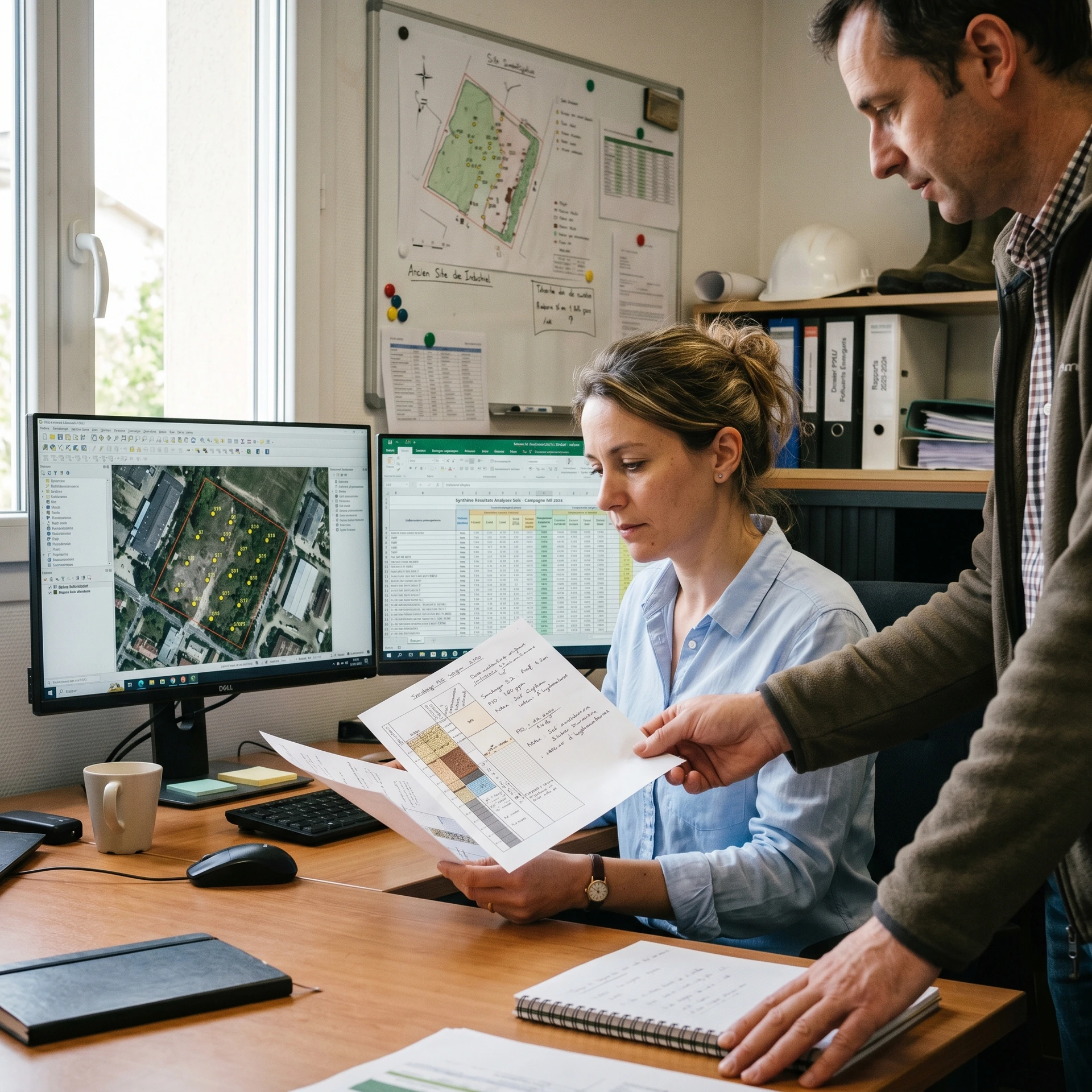
Soil investigation and PFAS analysis with TerraIndex

All three are about the same thing: not the individual measurement, but the coherence and traceability of the whole. That is exactly what a complete data chain provides.

The real problem is fragmentation

Most consultancies are perfectly capable of producing quality data. The challenge arises months or years later, when questions start to accumulate:

  • Where have we already sampled, and using which method?
  • What results were obtained, and which samples belong to this zone?
  • How have concentrations changed over time?
  • Can we demonstrate the connection between the field measurement, the analytical result and the conclusion in the report?

The information usually exists. The problem is fragmentation: some is in a PDF report, some in a spreadsheet, some in a service provider’s archive and the rest in a project manager’s inbox.

The result: data are present but difficult to use. In practice, data you cannot find are unusable data.

This fragmentation has a real cost, rarely visible in a budget: time spent searching, duplicate investigations, difficult reporting, knowledge lost during team changes and delayed decisions. As expectations grow, these inefficiencies matter more, because competent authorities, clients and other stakeholders now expect reliable, traceable and readily available information.

Four questions that reveal the maturity of your data chain

Before discussing tools, it helps to establish where your data chain stands today. These four questions provide a quick guide.

Dimension

The question to ask yourself

Retrieve

How long does it take to confirm whether a zone has already been sampled? A few seconds, or half a day?

Connect

Are your field and laboratory data in the same dataset, or must you reconstruct their relationship manually?

Defend

Can you demonstrate step by step how each result was obtained, from sampling to conclusion?

Preserve

If the project manager leaves tomorrow, does the project knowledge leave with them?

The more your answers resemble “a few seconds”, “the same dataset” and “yes, step by step”, the more confidently you can face an inspection, audit or client question.

A complete data chain from sample to conclusion
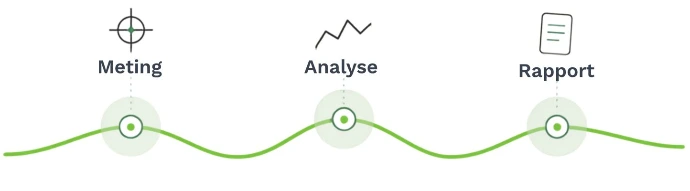
The most advanced organisations follow one simple principle: data continuity. Information is recorded digitally with its location directly in the field, centralised and made available to everyone involved. Data are no longer just a project deliverable; they become an asset you can query year after year.

Measurement, analysis, report


Three principles distinguish a structured chain from a collection of documents:

  • One source of truth.
    Field teams, laboratories and office staff work with the same dataset, not copies that diverge with each handover.
  • Traceability within the process, not in the archive.
    The connection between borehole, sample, analytical result and conclusion is established when the data are created, not reconstructed afterwards.
  • Fewer manual handovers.
    Each retyping step between the field, laboratory portal and spreadsheet is a known source of transcription errors. Fewer handovers tackle the risk at its source.

This is not a revolution. It is a logical evolution in working methods, one towards which the challenging characteristics of PFAS naturally push consultancies.

Strengthen your data chain: 8 tips from our experts

Eight tips you can apply today to strengthen your data chain before considering a new tool

Retrieve – make every piece of data findable
  • Use one systematic naming convention for points and samples (zone, campaign, point, depth), applied consistently across the team. Consistent coding turns a half-day search into a query taking seconds, even in a spreadsheet.
  • Record location at the source. Capture GPS coordinates when taking the sample, rather than from memory back at the office. Data tied to a point on a map are easier to trace, regardless of who was in the field.
Connect – maintain a register that outlasts campaigns
  • Maintain a master index for each site: one reference document listing every campaign, the sampled zones, the target analytes and where the report can be found. It is the contents page of your site history and the first reference when a file needs reopening months later.
  • Link analytical results to the sample ID on receipt, rather than storing them in a separate folder. The sample–result link is the one that breaks most often and is most expensive to reconstruct.
Defend – document choices, not just results
  • Record the reasoning behind analyte selection. Note why a particular PFAS list was chosen for a specific context. This makes a “negative” result defensible: you show that the analytical scope was reasoned, not simply accepted.
  • Build the chain of evidence as you go. At each step (sampling, laboratory order, result, interpretation), connect new data to the previous step as they are created. Reconstructing traceability afterwards costs much more and remains vulnerable.
Preserve – protect knowledge through team changes
  • Write a short site note for each project file: context, assumptions, key decisions and points requiring attention. One page that lets a colleague take over without starting from scratch.
  • Standardise handover points. A short checklist at each handover prevents transcription errors more effectively than a single final check.

None of these practices depends on software: they work on paper, in spreadsheets or in separate tools. The challenge is sustaining them, because every action relies on the manual discipline of a team under pressure. This is where an integrated system becomes valuable: it does not replace the principles, but automates them. Naming conventions, geolocation, the sample–result link and traceability stop being separate actions and become the default way data flow.

Why traditional methods are reaching their limits

The point above is not a judgement on teams; it is a question of scale. Keeping documents was sufficient when each file stood alone. Today, you need to retrieve, share, visualise and use data spread across sites, campaigns and years. In other words, turn a collection of documents into a genuine environmental knowledge base.

This is also what the Dutch system makes unavoidable. You do not build a chain of evidence the evening before a final report or inspection. You build it into everyday processes. Mandatory submission to the Dutch Key Register of the Subsurface (BRO) also makes reproducibility a given rather than an extra. Consultancies that have integrated this approach experience an audit as a routine check, not a stressful event.

PFAS are not just an environmental challenge. They are an information challenge too.
For PFAS, the challenge is shifting from more measurements to smarter investigation, broader interpretation and decision-making under uncertainty. This makes a traceable method and a complete data chain from sample to conclusion essential. They make a final judgement defensible even if standards become stricter later.

Frequently asked questions about PFAS soil investigation

What does PFAS regulation in the Netherlands cover?
The Netherlands uses the PFAS action framework (latest working version December 2023, update expected in 2026), which provides application values for reusing soil and dredged material. These values give effect to the duty of care and do not yet have formal statutory status, ahead of PFAS being incorporated into the Environment and Planning Act (Omgevingswet). Stricter drinking-water requirements also apply from early 2026, while a proposal for a universal PFAS restriction under REACH is being considered at European level.

Why are PFAS being regulated more strictly throughout Europe?
PFAS are persistent (“forever chemicals”) and spread widely through water, sludge and air. Five countries — the Netherlands, Germany, Denmark, Norway and Sweden — therefore submitted a proposal for a universal PFAS restriction under REACH, now with ECHA’s scientific committees. For soil investigation, this means stricter analytical requirements and greater emphasis on traceability throughout the project cycle.

Does a negative PFAS analysis guarantee that there is no risk?
Not necessarily. Common analyte lists cover only part of the PFAS family and can miss precursors and fluorotelomers. A “negative” result may therefore reflect an analytical scope that is too narrow. That is why documenting and explaining analyte selection matters.

What PFAS remediation options are available today?
There is no universal solution. Depending on the context, consultancies combine risk reduction, containment, excavation, removal and selected techniques (activated carbon, reverse osmosis); no technique treats all molecules equally well. Comparing these scenarios requires reliable, traceable data.